You love your husband. Your body still pulls away.
When touch feels loaded, sex feels like pressure, or you brace before you have time to think, the problem may not be a lack of love, or something you can solve by trying harder.
It may be Intimacy Shutdown™: a pattern in which your body has learned to protect you from the very closeness you consciously want.
I'm Carrie Cohen, a psychotherapist with more than 25 years of clinical experience and the creator of the Intimacy Response™ Method. I help women in committed relationships understand and change the protective responses that make intimacy feel difficult, pressured, or obligatory.

TheIntimacy Files
Three articles are live (Carrie's, Oct 26). "What is Intimacy Shutdown?" still shows Coming soon.

You want to want intimacy. But your body seems to have another plan.
You love him. You want to grow old with him. You may feel safe with him in most parts of your life.
And yet, when intimacy becomes possible, something changes.
- You stay busy at bedtime so there is less chance he will initiate.
- A hand on your back makes you wonder what he wants next.
- You brace when he moves toward you, even when the touch is gentle.
- You participate because you love him, but you are not fully there.
- You count how long it has been and feel responsible for keeping him from becoming disappointed.
- You feel relief when sex is no longer a possibility, and then feel guilty for being relieved.
That does not automatically mean your marriage is broken. And it does not mean something is wrong with you. It may mean your body has learned to experience intimacy as something it must anticipate, manage, endure, or avoid.
This is the pattern I call Intimacy Shutdown™.
Intimacy Shutdown™ is a protective response that can develop when physical or sexual closeness begins to feel connected with pressure, expectation, vulnerability, self-loss, conflict, or the need to take care of someone else's experience.
Your mind may know you love your husband. Your body may still tighten, go numb, distract, pull away, or prepare for what might be asked of you.
This is not a formal diagnosis. It is a way of naming a real and often confusing experience: loving your partner while your body responds to intimacy as if it needs protection.
Low desire may be part of the story. It may not be the whole story.
Low desire can have many causes, including hormonal changes, pain, medication, illness, exhaustion, stress, trauma, and relationship problems. Those factors deserve appropriate attention.
But low desire alone may not explain why your body braces when he touches you, why affection begins to feel like a request, or why you relax only after intimacy is off the table.
Those moments can point to a learned response to closeness, not simply an absence of sexual thoughts.

Protection does not always look like pulling away.
In my work, I see five common strategies women unconsciously learn to use in order to stay connected without feeling overwhelmed, exposed, dependent, or responsible for too much.
These patterns are not random. They are intelligent ways your mind/body started protecting you. But when they begin organizing physical intimacy, they can leave you close to the person you love while feeling far away inside your own body.
You learned to keep the peace.
You learned to need nothing.
You learned to earn it.
You learned to get ahead of it.
You learned to manage it.

A body-first approach to intimacy that does not ask you to override yourself
The Intimacy Response™ Method brings together nervous-system science, attachment theory, and relational work. It is designed to help you understand what your body is protecting, build more safety and choice around closeness, and practice new responses inside the relationship you want to keep.
The goal is not to make you more available for sex. It is not to talk you out of a no. And it is not to place the future of the marriage entirely on your shoulders.
The goal is for affection, vulnerability, and physical intimacy to stop feeling like experiences you have to manage from outside yourself.
I know this work clinically, and personally.
I have spent more than 25 years working clinically with women and couples, supported by 15 years of advanced postgraduate training in attachment, relationships, depth psychology, somatic work, and nervous-system science.
I also experienced ten years of Intimacy Shutdown™ in my own marriage. I loved my husband. I wanted our marriage. I understood a great deal about relationships, and my body still pulled away.
My husband and I found our way through that pattern, and I have now spent approximately twelve years on the other side of it in the same marriage.
Needs your yes: "approximately twelve years on the other side." You took this out in September as not on record. It's the first open question in Vera's ledger, and it's on four pages.


When you're ready to change it, not just understand it
Returning to Love™ is my four-month signature program for women who love their husbands and have been bracing, avoiding or pulling away from intimacy for months or years. We work directly with Intimacy Shutdown™ through the Intimacy Response™ Method, inside the marriage you want to keep.
Looking for a self-guided program or private work? See all the ways to work with me.




From women I've worked with
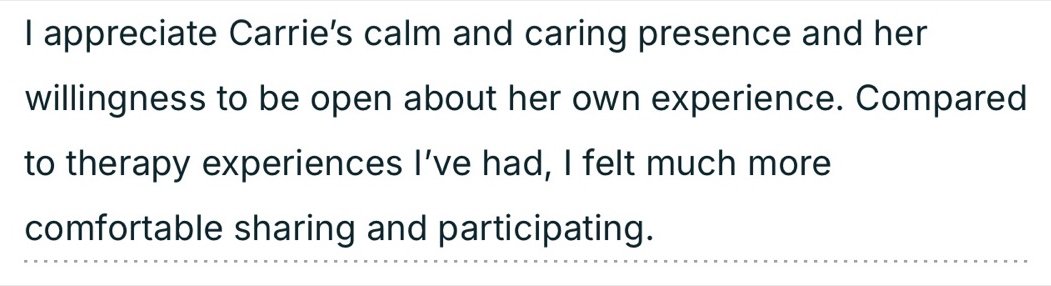

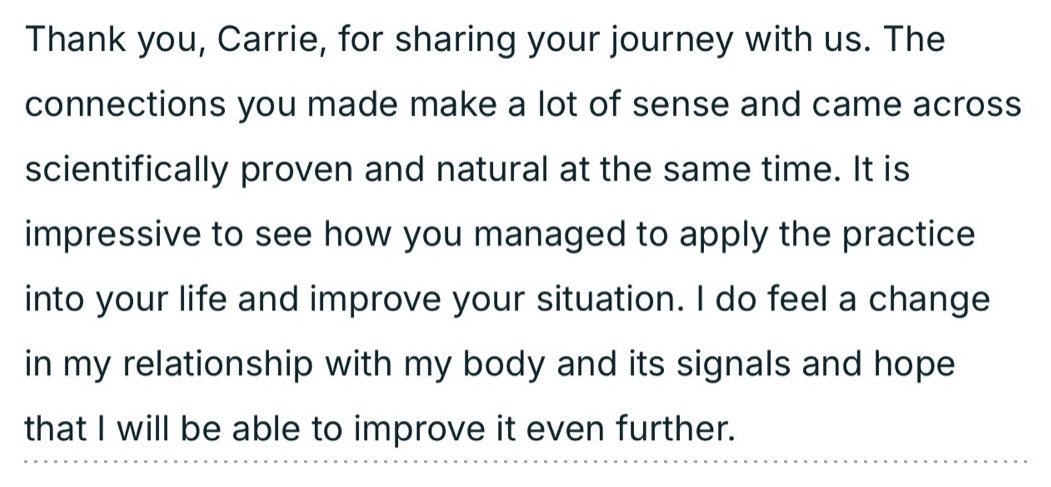
Before this goes live: these three are about how you lead, taken from the RTL folders. Same consent check as the Returning to Love™ page. Separately, the three business-coaching reviews from the template (Sarah M., Jessica R., Melissa T.) are still on your live homepage and need to come down.
Your body is not betraying you.
It learned to protect you. And learned responses can change without forcing desire, overriding a no, or abandoning yourself.
Begin by understanding what your body is protecting against.
You are not broken. Your body learned something, and learned responses can change.
If you love your husband but intimacy still activates something in you, begin by understanding what is actually happening. In my free masterclass, I explain why Intimacy Shutdown™ can persist in a loving marriage and what a body-first path forward can look like.
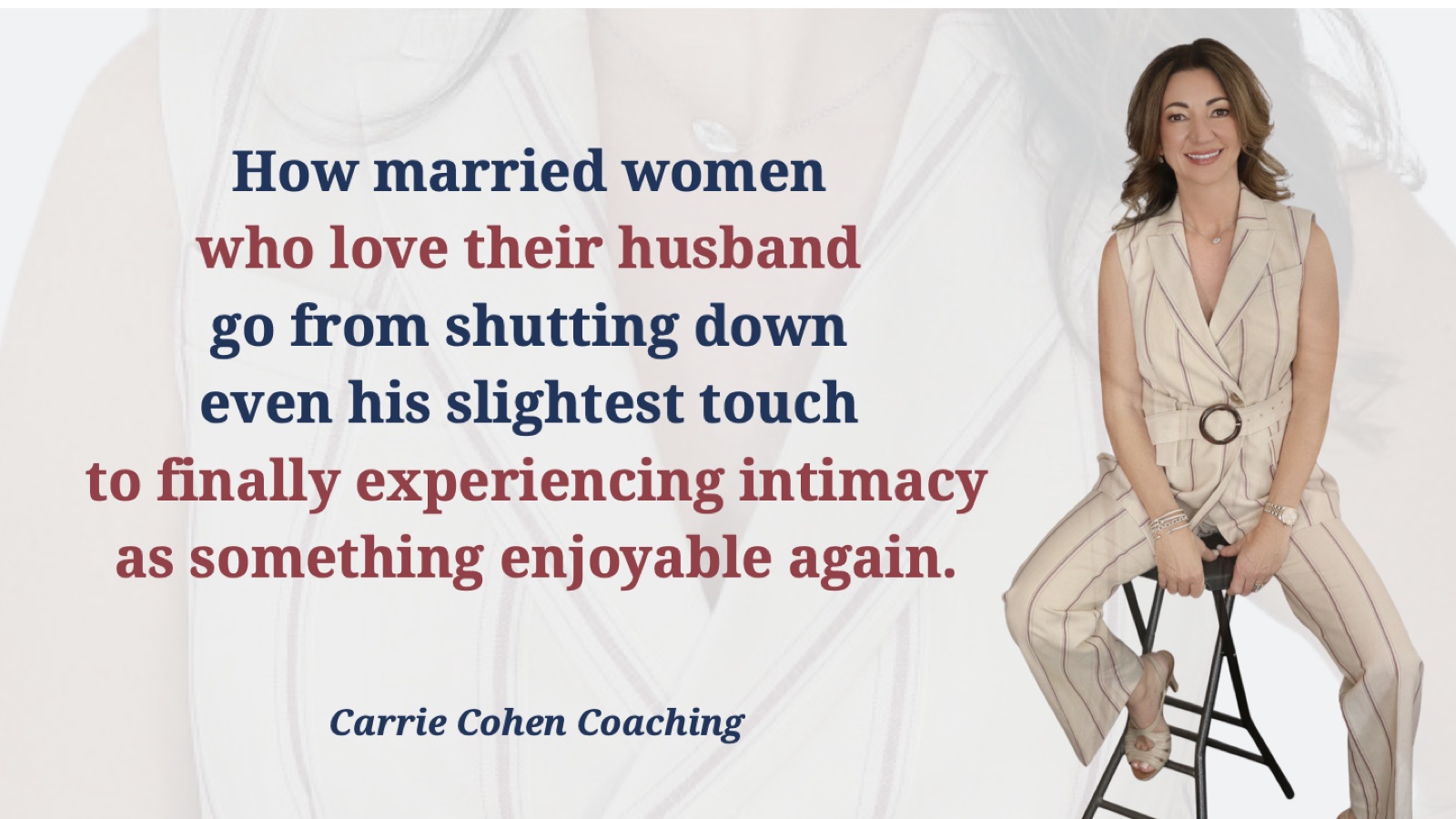
You love your husband. So why does your body pull away from him?
You know who he is. You know he is not the person who originally taught you to protect yourself. You trust him with your family, your future, and the life you have built together.
But when physical intimacy approaches, your body reacts before you can reason with it.
You tense. You distract yourself. You go quiet. You become irritated. You try to get through it. Or you avoid the moment entirely.
I call this pattern Intimacy Shutdown™.
What Intimacy Shutdown™ means
Intimacy Shutdown™ is a pattern in which a woman consciously loves and chooses her partner while experiencing automatic protection around physical or sexual closeness.
It can appear as bracing, freezing, numbness, avoidance, irritation, distraction, overthinking, obligation, or relief when intimacy is no longer expected.
The important distinction is that the body's response and the woman's conscious feelings about her husband do not seem to match. She may want the marriage deeply. She may even want to want intimacy. But in the moment, her system prepares, withdraws, or pulls away.
Intimacy Shutdown™ is not a formal diagnosis. It is language for a pattern many women recognize but have struggled to explain.
Changed one word: the copy said her system "disappears." "Disappear" is on your never-use list, so it reads "pulls away" here.

How it can look in ordinary life
- You stay downstairs until you think he is asleep.
- You avoid changing clothes in front of him because it might start something.
- You stiffen when he hugs you from behind in the kitchen.
- You cannot enjoy affection because you are tracking whether it will lead to sex.
- You start an argument or focus on a small annoyance when closeness begins to build.
- You go numb or mentally leave during sex.
- You agree out of obligation and count the experience as something you have handled.
- You feel responsible for his disappointment, so you monitor his mood before checking your own.
- You promise yourself you will initiate later, then feel dread as the time gets closer.
- You miss being close to him but also feel calmer when no closeness is expected.
Why love does not automatically switch protection off
Your responses to closeness are shaped by more than what you think about your partner today. Attachment experiences, earlier relationships, repeated pressure, painful or disconnected sexual experiences, family roles, stress, loss, and the ways you learned to stay safe can all influence what your body expects when intimacy appears.
If closeness became connected with obligation, exposure, conflict, disappointment, losing yourself, or caring for someone else at your own expense, your body may have learned to prepare before anything has even happened.
That is why insight can be meaningful and still not be enough. You can understand your history and love your husband while an automatic response continues to happen in the actual moment of touch.
Intimacy Shutdown™ is not the same as every form of low desire
Sexual desire changes across a lifetime. Hormones, perimenopause and menopause, pain, sleep, medication, illness, stress, caregiving, pregnancy, postpartum changes, attraction, resentment, and the quality of the relationship can all matter.
A medical evaluation, pelvic-floor care, sex therapy, trauma treatment, or couples therapy may be important depending on what you are experiencing.
Intimacy Shutdown™ becomes especially relevant when you notice protection: the bracing, anticipating, managing, freezing, numbing, or relief that appears around closeness even though you consciously want your relationship.

What this idea must never be used to do
Naming protection is not a reason to override your body. A no is still a no. Pain should not be pushed through. Intimacy should not be demanded, coerced, or treated as a debt owed to a partner.
This work is intended for women in relationships that are fundamentally safe. If there is abuse, coercion, fear, active betrayal, or ongoing violation of boundaries, the problem is not that your body needs to become more open. Appropriate safety and specialized support come first.
The Five Intimacy Protection Patterns™
Many women do not simply "avoid." They use strategies that once helped them stay connected and protected at the same time. In my work, I organize these strategies into Five Intimacy Protection Patterns™.
You may recognize one pattern strongly or see yourself in several. These are not diagnoses or fixed personality types. They are learned ways of navigating closeness.
You learned to keep the peace.
You learned to need nothing.
You learned to earn it.
You learned to get ahead of it.
You learned to manage it.

What change can look like
Progress is not measured only by how often you have sex. It may begin much earlier and more subtly.
- You notice the first moment of tightening before it takes over.
- You can receive a hug without immediately preparing for what comes next.
- You can tell the difference between a genuine no and an automatic protective response.
- You can stay connected to yourself while talking about intimacy.
- You can express a boundary without pulling away or managing his entire reaction.
- You can experience affection without making a decision about the whole evening.
- You have more choice, presence, and access to pleasure when the conditions feel right.
You do not need more shame.
You need an explanation that accounts for both truths: you love your husband, and your body has learned to protect itself around intimacy.
In my free Intimacy Shutdown™ Masterclass, I show you how this pattern develops, how the Five Intimacy Protection Patterns™ appear in everyday marriage, and where change begins.
The Intimacy Response™ Method
A body-first, relationship-aware process for the gap between what you consciously know and what your body automatically does.
A woman can understand her past, communicate thoughtfully, and genuinely love her husband, and still brace when he moves toward her.
The Intimacy Response™ Method was developed for that gap between what you consciously know and what your body automatically does.
It is a body-first, relationship-aware process designed to help women understand learned protection around closeness, develop more internal safety and choice, and bring new responses into the relationship they want to keep.

Three bodies of knowledge that are often discussed separately
Nervous-system science and somatic regulation
Help us recognize what happens in the body before thought takes over, and build the capacity to remain present without forcing or flooding.
Attachment theory
Helps us understand what closeness, dependence, receiving, vulnerability, and need came to mean through earlier relationships and experiences.
Relational work
Keeps the process connected to the actual marriage: the ways partners reach, respond, misread, pressure, withdraw, repair, and create safety together.
The neurobiology of safety is the thread connecting all three. Intimacy becomes more available when closeness no longer automatically requires protection or self-abandonment.
The four phases
Recognize the pattern
Most women notice the moment they pull away.
I want to help you get curious about what happened immediately before it.
What changed in your body? What thought appeared? What did you start anticipating? What did you suddenly want to do?
You begin recognizing your pattern while it's happening instead of only looking back afterward and wondering: Why did I do that again?
Regulate the response
Once you can recognize the pattern earlier, we work on what helps you stay present without forcing yourself through something you don't want.
This isn't about telling yourself your husband is safe until your body believes you.
It's about learning what helps YOU when your response starts changing.
Because what works for one woman may not be what works for another.
Retrain the signal
Understanding your pattern is important.
But understanding alone may not change what happens when your husband moves toward you.
Your response begins changing through new experiences.
That does not mean jumping straight from shutting down to having more sex.
It means creating correctly paced experiences of closeness that allow something different to happen.
Touch can stay touch. You can notice what you want. You can stop when you need to. You can stay connected without overriding yourself.
Over time, physical closeness no longer has to follow the exact same path it has followed for years.
Rewire inside the relationship
Eventually, this work has to make sense with the actual man you want to be close to.
Because your marriage isn't happening in a workbook.
Your husband may have his own feelings. He may be scared of rejection. He may not understand why something that feels safe to him doesn't always feel easy to receive.
You may need more time than he does. You may change your mind. Something that works beautifully one night may feel completely different another night.
This is where the work becomes specific.
Returning to Love™ helps you figure out how to apply what you're learning to what is actually happening between the two of you.
What this method is not
- It is not a demand to increase sexual frequency.
- It is not a way to override a no or tolerate pain.
- It is not a claim that hormones, health, trauma, or relationship conditions do not matter.
- It is not generic communication advice detached from what the body is doing.
- It is not a rejection of insight or psychotherapy. It addresses a layer that insight alone may not change.
- It is not appropriate as the primary response to abuse, coercion, acute crisis, or an unsafe relationship.

Where the method came from
The Intimacy Response™ Method grew from more than 25 years of clinical experience, 15 years of advanced postgraduate training, repeated patterns I observed in women and couples, and my own experience of Intimacy Shutdown™ in a marriage I deeply wanted.
My training includes attachment, nervous-system and somatic work, depth psychology, and relational and couples approaches. Rather than presenting any one tradition as the complete answer, I organize these lenses around the specific experience of a woman who loves her husband but whose body protects against intimacy.
My lived experience helps me understand the contradiction from the inside. My clinical training and experience shape how I hold and teach the work.
Where this method is taught
The Intimacy Response™ Method is the process taught inside Returning to Love™, my four-month signature program for partnered women experiencing Intimacy Shutdown™.
The Five Intimacy Protection Patterns™
Protection does not always look like fear. Sometimes it looks like being easygoing, independent, accomplished, prepared, or exceptionally good at managing everyone else.
These strategies may have helped you stay connected, competent, and safe. But when they begin organizing intimacy, it can become difficult to know what you want, receive affection, express a limit, or stay present in your own body.
I call these learned strategies the Five Intimacy Protection Patterns™. They are not diagnoses, and most women recognize more than one.
You learned to keep the peace
You became skilled at preventing disappointment, conflict, or emotional distance. Around intimacy, you may say yes before checking what you want, soften every boundary, or participate because saying no feels more difficult than getting through it.
The protection underneath: If everyone else is okay, the relationship can stay safe.
You learned to need nothing
You learned to rely on yourself, contain your feelings, and avoid needing too much from anyone. Closeness can feel exposing because receiving means allowing another person to matter, affect you, and see what you cannot manage alone.
Around intimacy, you may go emotionally quiet, disconnect from sensation, or prefer distance even while missing connection.
The protection underneath: If I need nothing, I cannot be disappointed, controlled, or left unprotected.
You learned to earn it
You learned that love, approval, or security came through being useful, successful, attractive, agreeable, or good. Intimacy can become another place to perform correctly rather than an experience you are allowed to inhabit.
You may evaluate yourself from the outside, worry about whether you are doing enough, or lose contact with pleasure because you are focused on being a good wife.
The protection underneath: If I do this well enough, I will remain worthy of love.
You learned to get ahead of it
Anticipation feels safer than surprise. You scan for signs, count the days, initiate before you are ready, or create distance before your husband can ask. Sometimes irritation or conflict appears just as closeness becomes possible.
The protection underneath: If I control when and how it happens, I will not be caught off guard.
You learned to manage it
You track his mood, his expectations, the timing, the children, the room, your body, and what might happen next. Even affection becomes work because you are trying to manage the entire experience from beginning to end.
The protection underneath: If I stay in charge of every variable, closeness may remain tolerable.
What comes after recognition
Naming your pattern is not about placing you in a box. It helps you notice the exact moment protection begins, and what your body expects will happen if it does not take over.
From there, the work is to build more choice. You can learn to remain connected to yourself, communicate what is true, and experience closeness without automatically keeping the peace, pulling away, performing, anticipating, or managing.
The quiz button ("Discover your primary Intimacy Protection Pattern™") stays off until the quiz exists. The quiz is on hold.
Ways to work with me
Start on your own tonight, join my live group program, or apply for private couples work.
Begin on your own, at your own pace
The Safety Code™
Understand what your body needs to feel safer with physical intimacy, so you can stop guessing and start changing the patterns that keep you bracing, avoiding or pulling away.
The Moment Between
Know what to do in the moment your body starts shutting down.
A simple body-first practice for women who notice themselves bracing, freezing, pulling away, or going quiet during physical intimacy.
Learn how to catch the pattern as it’s happening, create a small pause, and stay connected to what you actually want to do next.
Safe2Love Couples
For couples who love each other and keep getting pulled into the same distance, shutdown or misunderstanding. Eight self-paced weeks you work through together, so you can see the cycle earlier and build closeness that feels safe for both of you.

Returning to Love™
Ready to change Intimacy Shutdown™? Learn how Returning to Love™ helps you retrain long-standing patterns so you can feel more comfortable with touch, know what you want, and experience closeness and desire with your husband again.
When your marriage needs more than another conversation about the same problem
For couples who love each other, want their marriage, and are ready for highly individualized support with the patterns they haven’t been able to change on their own.
Over four months, we work closely together to understand what keeps happening between you, what each of you brings into those moments, and what needs to change for communication, connection, and physical intimacy to actually feel different.
This is intensive, personalized work shaped around your marriage, not a standard couples therapy format.
No prices on this page, per you. Each price lives on its program's own page.
Not sure where to begin?
Start with the free Intimacy Shutdown™ Masterclass. It will help you understand whether the pattern I describe matches what is happening for you and introduce the body-first approach behind my work.
The Intimacy Reset
Your copy goes here.
Needs your copy: who it's for, what's inside, the price and the checkout link. The layout matches The Safety Code page: hero, who it's for, what's inside, then the investment.

When your marriage needs more than another conversation about the same problem
For couples who love each other, want their marriage, and are ready for highly individualized support with the patterns they haven’t been able to change on their own.
Over four months, we work closely together to understand what keeps happening between you, what each of you brings into those moments, and what needs to change for communication, connection, and physical intimacy to actually feel different.
This is intensive, personalized work shaped around your marriage, not a standard couples therapy format.

I spent years understanding relationships. My body still did not feel safe inside intimacy.
Psychotherapist, intimacy specialist, and creator of the Intimacy Response™ Method.
I'm Carrie Cohen, a psychotherapist with more than 25 years of clinical experience. I specialize in helping women who love their husbands but freeze, brace, avoid, disconnect, or feel responsible for managing physical intimacy.
My work integrates nervous-system science and somatic regulation, attachment theory, and relational work. At the center is one question: What allows a woman to remain connected to herself while she is close to someone she loves?

Why I do this work
For Marie: embed the Vimeo video here: https://player.vimeo.com/video/1218955004?h=628fa76afb (it's unlisted, so it can be embedded without being searchable on Vimeo). In Vimeo, set the thumbnail to the frame at 2:01, where Carrie is looking at the camera. The current thumbnail catches her mid-word. Under Embed settings, turn off the title, byline and portrait, and set the player color to navy #003B73.
My clinical path
I began my career after graduating from New York University and went on to complete 15 years of advanced postgraduate training. My studies have included depth psychology, attachment, couples and relational work, somatic approaches, and nervous-system science.
My advanced training includes established couples and relational approaches. Those traditions inform my background, but no single model fully organized the pattern I kept seeing: women who understood their histories and loved their partners, yet whose bodies still protected against intimacy.
Over time, I began bringing these areas of knowledge together around the neurobiology of safety in closeness.
Why this work is personal
For ten years, I experienced Intimacy Shutdown™ in my own marriage.
I loved my husband. He was the person I wanted to build my life with. I could understand my patterns and explain what was happening, and still, when intimacy approached, my body tightened and pulled away.
That contradiction became impossible for me to ignore. Knowing why something happened did not automatically change what happened in the moment.
My husband and I worked through that pattern. I have now spent approximately twelve years on the other side of Intimacy Shutdown™ in the same marriage.
I do not share that story because lived experience replaces professional training. It does not. I share it because I know the shame and confusion of loving a good man while your body seems to say something else.
Needs your yes: "twelve years on the other side" again.

- Nervous-system science and somatic regulation
- Attachment theory
- Relational and couples work
The neurobiology of safety is the thread connecting all three.
The copy guide says no intimate family photos without your OK. This beach photo of you and your husband is already on your homepage draft, so I assumed it's approved. Swap it if not.
What I developed
Through clinical work, advanced training, observation, and lived application, I developed the Intimacy Response™ Method and the Five Intimacy Protection Patterns™.
The method gives women a way to understand the protection beneath their responses, build more internal safety and choice, and practice intimacy without forcing desire or abandoning themselves.
My goal is not to help a woman perform closeness more successfully. It is to help her become more present, more connected to what is true for her, and more able to experience intimacy without the same automatic protection.
Credentials
- Psychotherapist with more than 25 years of clinical experience
- New York University graduate
- 15 years of advanced postgraduate training
- Training across attachment, depth psychology, couples and relational work, somatic approaches, and nervous-system science
- Creator of the Intimacy Response™ Method and the Five Intimacy Protection Patterns™
Needs your answer: your exact degree, license letters, and whether the license state or number shows publicly.
You are not the only woman living inside that contradiction.
If you love your husband but your body still pulls away, you do not have to keep explaining it as a failure of love.

You love your husband. You want your marriage. And you don't want to spend the rest of it pulling away from physical intimacy with him.
Maybe you brace when he moves toward you.
You avoid the kiss because you don't know where it's going to lead.
You stay up a little later because it's easier to come to bed when he's already asleep.
Or you have sex because you know once you do, you'll get a few days where you don't have to wonder if tonight is going to be the night.

This isn't one night when you're not in the mood.
It's become a pattern.
And the hardest part is that you don't want to keep feeling this way.
You love your husband.
You want to enjoy his touch.
You want to be able to move toward him because YOU want to.
Maybe you even find yourself thinking:
I want to want him again.
This is the pattern I call Intimacy Shutdown™.
And it's the work we do inside Returning to Love™.


My 4-month program for women who want help changing this pattern
Returning to Love™ is my 4-month program for women who love their husbands but have spent months or years bracing, avoiding, anticipating or managing physical intimacy and want help changing that pattern.
This is not about making yourself have more sex.
It's not about becoming a woman who wants sex all the time.
And it's not about convincing yourself that you should want your husband because he's a good man and you have a good marriage.
I want you to be able to know what YOU want again.
- To enjoy the kinds of touch you actually want.
- To stay present with your husband instead of immediately wondering what comes next.
- To be able to feel your own yes, your own desire and your own pull toward him.
- And to stop spending so much energy anticipating, avoiding or managing this part of your marriage.
Maybe you've been trying to understand this for years.
You've wondered if it's your libido. Your hormones. Menopause. Your marriage. Your history. Your attachment style.
Maybe you've gone to therapy.
Maybe you and your husband have talked about it more times than you can count.
Maybe you understand yourself much better than you used to.
And yet the actual moment hasn't changed.
- Your husband moves toward you and you still pull away.
- The kiss starts to feel like too much.
- You find yourself wondering where his hand is going next.
- You realize it's been a week since you've had sex and suddenly you're doing the math.
You know he's a safe man.
You know you love him.
But knowing those things hasn't necessarily changed what happens when physical intimacy is actually happening.
That's where I want you to start looking at this differently.



Intimacy Shutdown™ isn't the same as simply wanting less sex.
There's a difference between not wanting sex tonight and spending the whole day wondering how you're going to avoid it tonight.
There's a difference between wanting to cuddle without having sex and no longer being able to relax into cuddling because you've spent years wondering if it will lead somewhere.
There's a difference between having lower desire than your husband and realizing you've slowly stopped knowing what kind of physical closeness you want at all.
And there's a difference between being perfectly content wanting less sex and thinking:
I miss this part of myself.
I want to enjoy being close to him.
I don't want this to be the rest of our marriage.
That's the woman I created Returning to Love™ for.
You don't need another person telling you to "just relax."
One of the most confusing things about Intimacy Shutdown™ is that your reaction may not make logical sense to you.
You may have a kind, loving, supportive husband.
You may trust him.
You may genuinely enjoy being around him.
And still notice yourself bracing when he moves toward you.
That doesn't automatically mean something is wrong with your marriage.
And it doesn't automatically mean you've stopped loving or wanting your husband.
I understand Intimacy Shutdown™ as a repeating pattern that can develop around physical intimacy over time.
Eventually, the anticipation itself can become part of the experience.
- A kiss isn't only a kiss anymore because part of you is already wondering what comes after it.
- Getting into bed isn't only getting into bed because you're wondering if he's going to initiate.
- A hand on your leg can stop feeling neutral because you're already trying to figure out where it's going.
So inside Returning to Love™, we don't start by asking you to push through those moments.
We start by helping you understand your particular pattern.


What we actually work on
The work happens in four phases.
Recognize the pattern
Most women notice the moment they pull away.
I want to help you get curious about what happened immediately before it.
What changed in your body? What thought appeared? What did you start anticipating? What did you suddenly want to do?
You begin recognizing your pattern while it's happening instead of only looking back afterward and wondering: Why did I do that again?
Regulate the response
Once you can recognize the pattern earlier, we work on what helps you stay present without forcing yourself through something you don't want.
This isn't about telling yourself your husband is safe until your body believes you.
It's about learning what helps YOU when your response starts changing.
Because what works for one woman may not be what works for another.
Retrain the signal
Understanding your pattern is important.
But understanding alone may not change what happens when your husband moves toward you.
Your response begins changing through new experiences.
That does not mean jumping straight from shutting down to having more sex.
It means creating correctly paced experiences of closeness that allow something different to happen.
Touch can stay touch. You can notice what you want. You can stop when you need to. You can stay connected without overriding yourself.
Over time, physical closeness no longer has to follow the exact same path it has followed for years.
Rewire inside the relationship
Eventually, this work has to make sense with the actual man you want to be close to.
Because your marriage isn't happening in a workbook.
Your husband may have his own feelings. He may be scared of rejection. He may not understand why something that feels safe to him doesn't always feel easy to receive.
You may need more time than he does. You may change your mind. Something that works beautifully one night may feel completely different another night.
This is where the work becomes specific.
Returning to Love™ helps you figure out how to apply what you're learning to what is actually happening between the two of you.

Because knowing what to do and doing it inside your marriage are two different things.
This is one of the biggest reasons Returning to Love™ exists.
You can learn a concept and completely understand it.
And then your husband hugs you from behind while you're cooking and your body reacts.
You can plan to practice physical closeness together and discover that the expectation of doing it changes the entire experience.
You can know that you're allowed to pause and still have no idea whether you should pause, keep going or try something different in that particular moment.
You can know you need to communicate and still need time to understand what YOU want before you're ready to explain it to him.
This work gets individual very quickly.
Inside Returning to Love™, we take the ideas out of your head and look at what is actually happening in your marriage.
Not so you can do the work perfectly.
So you can stop guessing.
What can start to change?
Sometimes the first change is very small.
- You notice yourself staying present during a hug instead of immediately pulling away.
- You realize you actually WANT to put your head on his shoulder.
- You enjoy his hand on your body without your mind immediately jumping ahead.
- You recognize yourself getting overwhelmed and know what to do instead of forcing yourself through it.
- You and your husband have a different experience in a moment that used to end in frustration.
Those moments matter because the goal of this work isn't to make you better at tolerating physical intimacy.
I want you to have access to the closeness you actually want.
This is the direction of the work.
Not more obligation.
Not better performance.
More access to yourself inside intimacy.
What women inside Returning to Love™ are noticing.
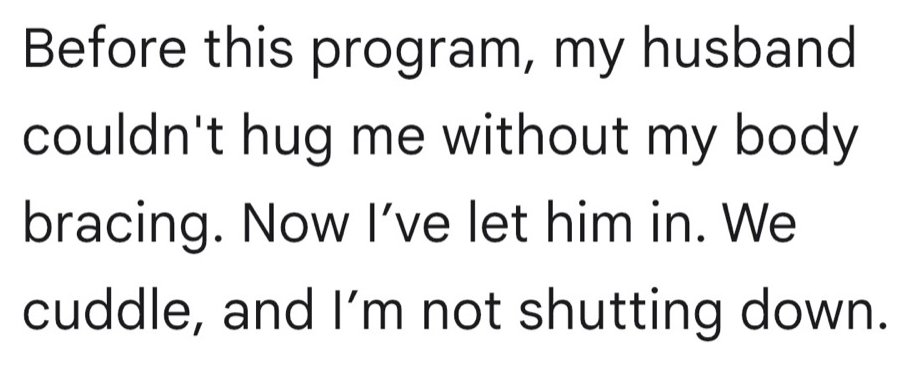
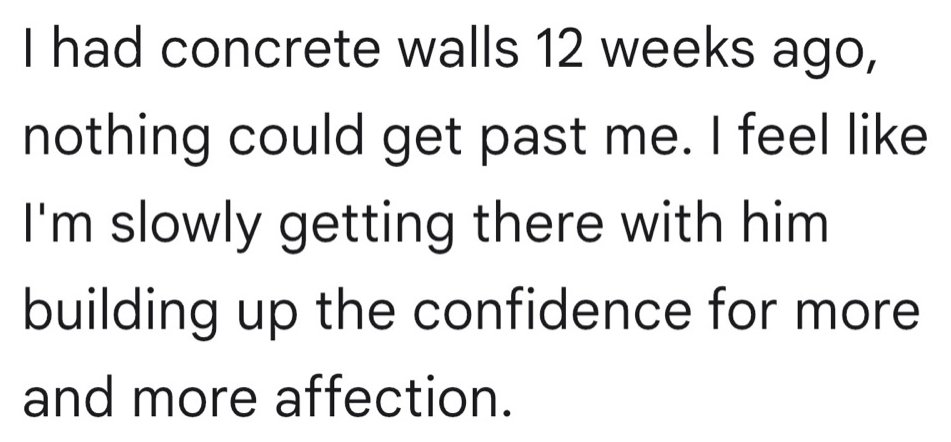
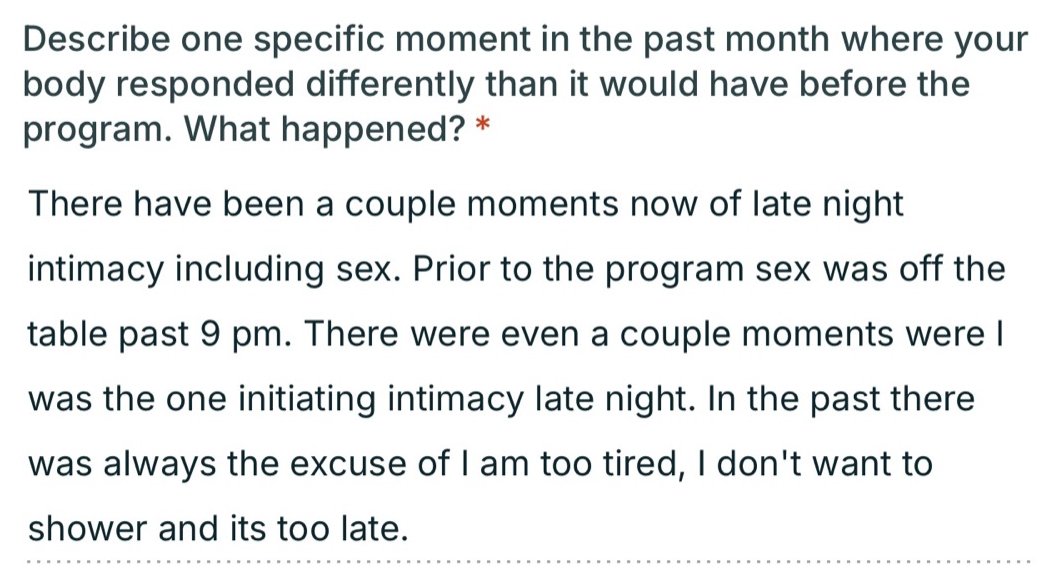
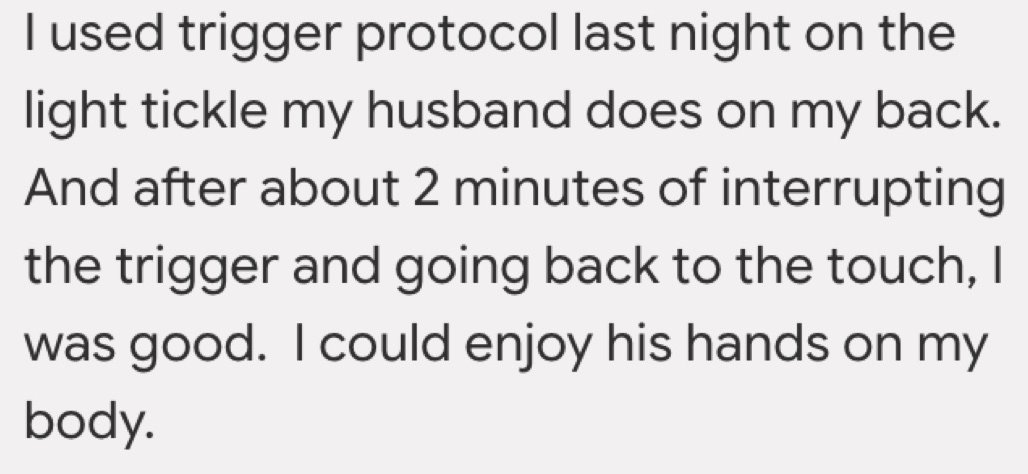
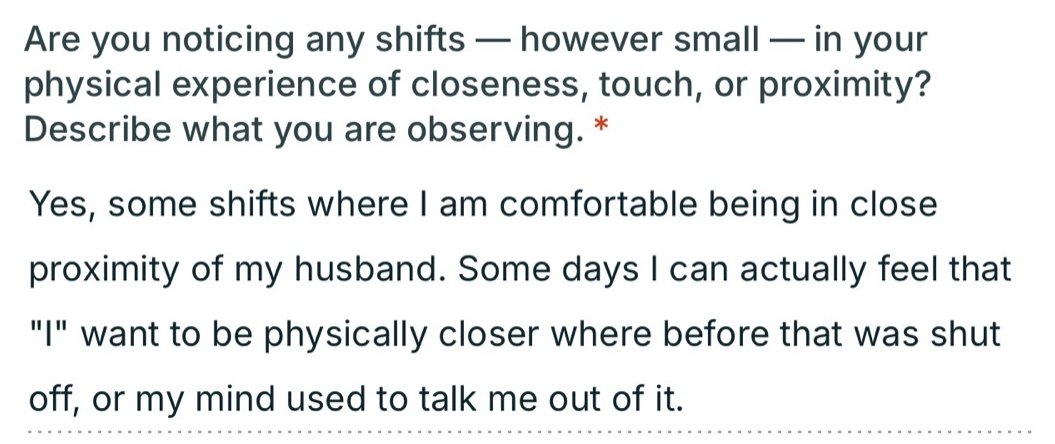
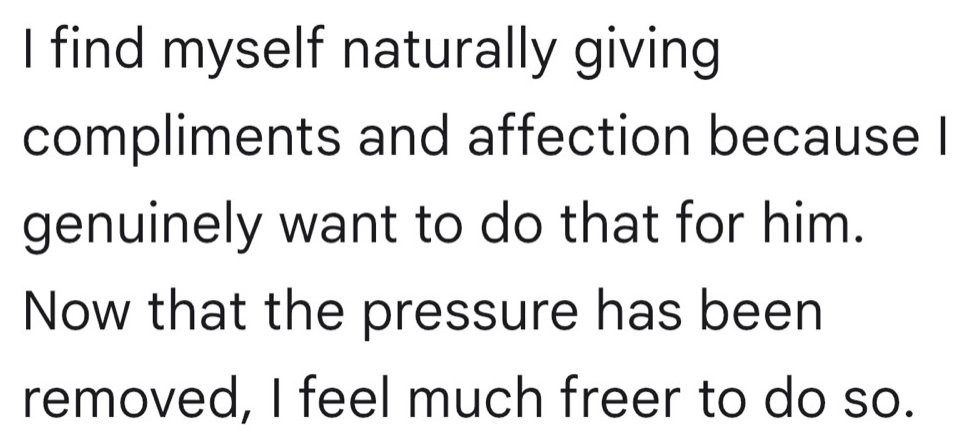
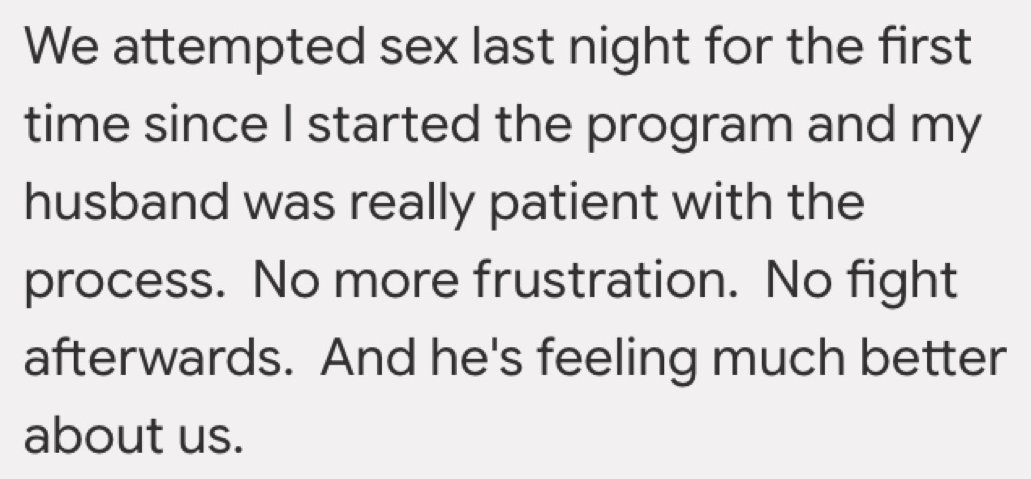
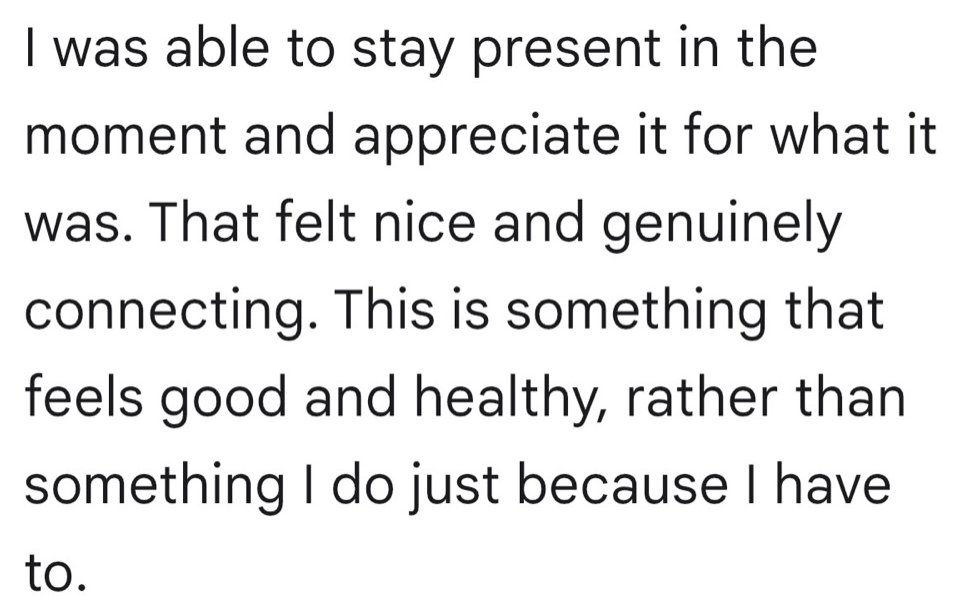
Before this goes live: all eight are from the RTL check-in forms and Phase folders. Each woman needs to OK her words on your public website, and if any are in the current cohort, that is a second check. No names show on any of them.
This isn't couples therapy.
And your husband doesn't need to become the client.
Returning to Love™ is centered on YOU, because the change happens in your nervous system.
You begin by understanding your own responses, your own wants and your own patterns around physical intimacy.
Your husband has his own learning to do, too. Over the years, he's developed his own ways of responding to this pattern.
So he's part of the work. He learns what's actually happening in your body and how to support you in the moments that used to go wrong.
Returning to Love™ is built for you on your own and for the two of you together. Some of the work is yours alone, and some of it you do with him.
You're not training him to behave perfectly enough that you'll want sex.
You're changing the pattern the two of you have been living inside, so physical closeness can start to feel different for both of you.
One woman described getting overwhelmed while she and her husband were practicing physical closeness:
“We both knew what to do. And it felt so good to have his support.”
That is very different from both of you standing in the same old moment with no idea how to get out of it.

What it's like inside Returning to Love™
Returning to Love™ is a structured, live 4-month program.
You move through the work with a small group of women who are experiencing their own versions of Intimacy Shutdown™.
We meet weekly for live sessions where we take what you're learning and apply it to the real moments happening in your marriage.
Changed one word: your copy says "live clinical sessions." You banned calling coaching sessions clinical on Sept 13 (it was on the old Safe2Love page), so it reads "live sessions" here. Put it back only if you've changed that ruling.
You also receive the curriculum, practices and tools that guide you through the work between sessions.
This is not four months of sitting in a group talking about your sex life.
And you are never required to share something simply because you're in a group.
The group gives you something many women have never had around this issue:
The experience of realizing you are not the only woman who loves her husband and still struggles with this.
One woman told me:
“I was initially nervous about a group. But Carrie manages the dynamic so well that everyone has plenty of time to share if they want.”
The women may have different marriages and different histories.
But there is often an enormous relief in no longer being the only person in the room thinking:
Why am I like this when I love him?
Check before it's public: every quote on this page needs that woman's OK to be on your website. Consent was still an open question on the masterclass testimonials.

Who Returning to Love™ is for
Returning to Love™ is for a very specific woman.
You are in a committed relationship or marriage with a man you love and want to stay with.
This has become more than an occasional night when you don't want sex.
For months or years, you've found yourself bracing, anticipating, avoiding, managing or pulling away from physical intimacy.
And importantly: YOU want that pattern to change.
Not simply because your husband wants more sex.
Because you miss something.
- Maybe you miss enjoying his touch.
- Maybe you miss wanting to move toward him.
- Maybe you want affection to feel easy again.
- Maybe you want to know what YOU want instead of constantly responding to what you think he wants.
- Maybe you're scared that if you don't do something, another five or ten years will pass and you'll still be having the same experience.
You don't need to know exactly what you want your intimate life to look like.
You just know:
I don't want to keep doing this.
Returning to Love™ may not be the right fit if...
- You are currently separated, actively divorcing or unsure whether you want to remain in your relationship.
- You are currently in an unsafe or abusive relationship.
- You are looking primarily for trauma-processing therapy or crisis support.
- Or you are actually comfortable with the amount of physical intimacy you want and are only looking for a way to make yourself want more because your husband does.
I don't believe every woman who wants less sex needs to be fixed.
Returning to Love™ is for the woman who is saying:
I want something different for ME.

Why I created this work
I'm Carrie Cohen.
I'm a psychotherapist, and I specialize in Intimacy Shutdown™ in women who love their husbands.
I've been a therapist for more than 25 years.
And for 10 years of my own marriage, I was also the woman pulling away.
I loved my husband.
I wanted my marriage.
We spent years trying to understand what was happening, including a significant amount of couples therapy.
I gained insight.
I understood more.
And I was still shutting down around physical intimacy.
That experience changed the way I understand this problem.
Because there can be an enormous gap between understanding WHY something is happening and knowing how to change what actually happens when your husband moves toward you.
That gap is where much of my work lives now.
Returning to Love™ grew out of both my clinical work and my lived experience of finding my own way through Intimacy Shutdown™.
And no, I don't believe every woman's story is the same as mine.
But I do know what it's like to love the man you're married to and wonder why this one part of your relationship feels so hard.
I also know what it's like when it doesn't feel that way anymore.
If you're reading this thinking, "This is me," start here.
You do not need to decide whether Returning to Love™ is right for you today.
First, I want you to understand what may be happening and what it actually takes to begin changing this pattern.
That's why I created my free Intimacy Shutdown™ Masterclass.
In it, I'll show you how I think about Intimacy Shutdown™, why understanding the pattern alone may not have changed it, and how you can begin finding your way back to the physical closeness you actually want with the man you love.
If you've been living this for months or years and you don't want it to be the rest of your marriage, this is where I'd start.
TheIntimacy Files
Clear language for the intimacy struggle no one has been able to name
If you have ever thought, "I love him, so why does my body react this way?" you are in the right place.
These articles explore Intimacy Shutdown™, the Five Intimacy Protection Patterns™, affection that has become loaded, the difference between low desire and protection, and the body's role in long-term intimacy.
How the blog works: three articles are written (Oct 26). The grayed cards are the next titles from your copy. Your guide says publish only finished articles, so the grayed cards come off before the domain switch.

You’re standing in the kitchen when your husband comes up behind you and puts his arms around you. Imagine that, before you’ve even thought about whether you want a hug, your shoulders tighten. You find something that needs doing and move away.
Later, you wonder why. You love him. You miss feeling close to him. So why does something as ordinary as his touch feel difficult?
You can love your husband and still feel uncomfortable when he touches you. The useful question is what you’re responding to: the touch itself, physical discomfort, something happening between you, or what you expect the touch will lead to. Those experiences can look similar, but they need different kinds of attention.
I’m especially interested in what happens when this has become a pattern. You’ve been pulling away for months or years. You’ve started organizing your evenings around avoiding the possibility of intimacy. And you want something different because you miss being able to enjoy closeness yourself.
What happens just before you pull away?
When I think about this with a woman, I want to slow the moment down.
Does his touch feel unpleasant as soon as it happens? Were you already overwhelmed before he came near you? Or does the tension arrive when you start wondering whether he wants more?
There’s a difference between wanting space after a demanding day and wanting a hug while feeling unable to receive it. There’s also a difference between disliking a particular kind of touch and feeling guarded around almost any affection.
Your preferences deserve attention without needing to become a problem to solve. You’re allowed to dislike being touched while cooking. You’re allowed to want a shorter hug. A particular no doesn’t tell us that you have difficulty with intimacy.
What I’m listening for is the repeated experience of wanting closeness, then losing access to what you want once it becomes possible.
When affection becomes something you manage
Consider a hypothetical evening. You’d like to sit beside him on the couch, but you choose the chair instead. You’re already thinking about whether sitting close will seem like an invitation. The chair feels easier because you won’t have to decide what to say later.
That’s what I want you to notice. The difficulty is affecting your choices before any touch happens.
In my work, I look at how anticipation, physical tension, and the urge to withdraw fit together. Sometimes earlier experiences of closeness help explain the pattern. Sometimes the relevant history is inside this marriage: unresolved hurt, pressure, or repeated moments of agreeing when you didn’t want to.
I use Intimacy Shutdown to describe an established pattern of bracing, withdrawing, or disconnecting around intimacy. It’s my term for a pattern, not a formal diagnosis. I wouldn’t apply it simply because you have less desire than your husband or don’t want to be touched tonight.
A good husband doesn’t answer every question
You may keep returning to how kind he is, as if that should settle the matter.
But knowing he loves you doesn’t tell you what you experience when he comes close. You can trust his intentions and still worry that you’ll disappoint him. You can want your marriage and have difficulty identifying what kind of affection you actually enjoy.
And being a loving husband includes respecting the limits you express. If he continues after you’ve asked him to stop, that behavior needs to change. Your work on your response cannot replace his responsibility for his actions.
I also wouldn’t assume every difficult response to touch is protective. Pain, hormonal changes, medication effects, stress, and relationship difficulties can contribute to sexual concerns. Mayo Clinic explains how these factors can overlap. If touch is painful or this is a sudden change, include a healthcare professional in understanding what’s happening.
Why knowing the reason may leave you stuck in the moment
Perhaps you’ve already done meaningful work in therapy. You understand your history. You and your husband communicate more openly than you used to.
Then he moves toward you, and you still tense up.
I wouldn’t dismiss what you’ve learned. I’d ask where that understanding becomes difficult to use. Can you recognize the tension as it begins? Do you know what you’d prefer? Can you express it without immediately withdrawing the request because he looks disappointed?
That’s one part of Recognizing the Response, the first phase of my Intimacy Response Method. We pay attention to your particular sequence so there’s more room for you to make a choice.
A practical first step: look back at one ordinary moment
You don’t need to wait until he touches you again or turn tonight into a practice session. Think back to one recent moment and make three short notes:
- What was happening just before I pulled away?
- What did I notice first: discomfort, tension, a thought, or an urge to leave?
- What would I have preferred in that moment?
You might discover that you wanted the hug to end, that you wanted different touch, or that you wanted reassurance it wouldn’t become anything more. You might not know yet. That’s useful information too.
If you choose to discuss it, describe that specific moment rather than trying to explain your entire relationship with affection. You could say, in your own words, that you wanted to sit close but were worried about what might be expected afterward.
You can pause or stop touch while you’re figuring this out. You don’t need a complete explanation to have that choice.
When you want closeness to feel different
What I want for you is the ability to notice what you feel, know what you prefer, and participate in affection you actually want. That gives us a more useful direction than asking how you can stop pulling away at any cost.
If you recognize this longstanding pattern and want help understanding it, watch my free intimacy masterclass. It’s a next step toward exploring the work I do with women who love their husbands and want their experience of intimacy to change.
If you recognized yourself in this
The next place to go is my free masterclass.

You know you want your marriage. What you can’t work out is why you rarely want s*x inside it.
Perhaps you’ve spent years trying to understand this. You’ve talked about your relationship, considered your hormones, read about desire. You can explain quite a lot about yourself. Yet when intimacy becomes a possibility, you still feel yourself preparing to avoid it or get through it.
Loving your husband and wanting s*x aren’t the same experience. Low desire can involve health, medications, hormonal changes, stress, and the relationship itself. It’s also worth examining what you expect from an intimate moment: pleasure and choice, or something you’ll need to manage.
I want to understand both what may be making desire difficult and what you personally miss. Do you want more interest? More pleasure? The ability to stay present? Those questions give us a direction that counting how often you have s*x cannot.
Start with the experience you’re having
It’s easy to measure desire by whether you initiate or how long it’s been. But those measures leave out much of the experience.
When you think about intimacy, do you imagine something enjoyable? Are there things you would like to ask for? Or does your attention immediately go to how long it will take, whether you’ll be able to stay engaged, and how he’ll feel if you say no?
I’m interested in that shift in attention. If you spend the entire moment monitoring yourself and his reactions, there may be very little room to notice interest or pleasure.
That doesn’t establish a single cause. It tells us something specific to explore alongside the rest of your circumstances.
Mayo Clinic describes sexual concerns as involving physical, emotional, and relationship factors. Pain, a medication change, or symptoms around menopause deserve attention with an appropriate healthcare professional. You don’t have to decide that the explanation is either physical or emotional before seeking help.
Does desire have to come first?
You may expect desire to arrive before any affection begins. Sometimes it does. Sometimes interest develops during an experience you already welcome and enjoy. This is often called responsive desire.
For example, in a hypothetical moment, you might feel open to kissing without feeling sexually interested yet. As you enjoy the kiss, interest develops. Cleveland Clinic explains that desire and arousal don’t always happen in the same order.
The word welcome matters here. Being curious about a kiss is different from agreeing to unwanted s*x because you’re hoping you’ll eventually want it.
You’re allowed to be open without promising a particular outcome. You can stop. Desire might develop, or it might not, and neither result creates an obligation to continue.
Responsive desire shouldn’t become another instruction you use against yourself: I should start because I might enjoy it later. If you don’t want to begin, that no deserves respect.
When wanting to want him becomes pressure
You may miss desire so much that you start checking for it constantly.
Am I interested now? Did I enjoy that enough? If last night felt good, why don’t I want it again today?
In my work, I pay attention to when trying to improve intimacy becomes another demand the woman is managing. She may be participating more often while feeling just as disconnected from herself.
That’s why I want a broader understanding of change. Can you tell when you’re interested? Can you ask for something different? Can you remain aware of your experience and stop when you want to?
Those questions keep your own wants at the center of the work.
Where Intimacy Shutdown fits
If this has been happening for a long time, you may have developed ways to avoid the difficult moment altogether. Staying up later. Keeping affection brief. Being so busy that initiation rarely becomes possible.
You want closeness, yet you’ve arranged parts of your life around avoiding it.
I call that established pattern of bracing, withdrawing, or disconnecting Intimacy Shutdown. It’s a category I use in my work, not a formal diagnosis or an explanation for every woman’s low desire.
Lower interest alone doesn’t establish this pattern. Neither does having different preferences from your husband. If you’re considering questions about asexuality or your orientation, those deserve room on their own terms, without assuming an identity is a protective response that needs changing.
What brings us to this work is your wish to change an experience that feels limiting to you.
A practical first step: describe what you want back
Before you make a plan to have more s*x, finish this sentence privately:
What I miss, or would like to experience, is…
Be specific. Perhaps you want to enjoy kissing without mentally preparing for the rest of the evening. Perhaps you want to stay present enough to notice pleasure. Perhaps you want to feel comfortable telling him what you like.
Then ask: What gets difficult just before that becomes possible?
You’re looking for an observation, not a diagnosis. Pain suggests a different next step from fear of disappointing him. Being too exhausted to notice interest suggests a different conversation from disliking the way intimacy usually unfolds.
This is where I’d begin applying Recognizing the Response in my Intimacy Response Method: understanding your experience clearly enough to choose a relevant next step. You don’t need to test yourself through unwanted intimacy to gather that information.
You get to want a different experience for yourself
You can care deeply about your husband and want intimacy to change because you miss something too.
I want that part of the conversation to have space. Your pleasure, your preferences, and your ability to choose belong in the picture alongside your commitment to your marriage.
If you recognize the longstanding pattern of bracing or disconnecting, watch my free intimacy masterclass. It’s an invitation to explore the approach I use with women who want more access to their own experience of closeness.
If you recognized yourself in this
The next place to go is my free masterclass.

Imagine wanting to cuddle with your husband, then deciding against it because you don’t want to explain later that cuddling was all you wanted.
You miss affection. But accepting it seems to create a question you’ll eventually have to answer. So you keep the kiss brief, move away from his hand, or sit somewhere else.
When every touch feels like it will lead to s*x, the difficulty may be the expectation attached to affection. You’re anticipating a request, a negotiation, or disappointment before you’ve had a chance to enjoy the contact. A useful first step is to identify what you expect will happen and whether that expectation reflects his current behavior, your shared history, or both.
You’re allowed to want a hug that stays a hug. Enjoying affection doesn’t commit you to anything afterward.
What are you deciding when he moves toward you?
Think about what’s actually happening in that moment.
Are you noticing whether you like his hand on your back? Or are you deciding whether leaving it there will give him the wrong idea?
That second question can take over quickly. You start thinking about how long it’s been since you were intimate. You consider whether he’ll feel rejected. You try to predict what will happen if you relax into the touch.
By then, you’re occupied with what comes next. Your own preference is harder to hear.
This is why I wouldn’t begin by telling you to initiate more affection. I’d want to understand what initiating would mean to you and what has happened when you’ve tried before.
Is he expecting more, or are you anticipating it?
Sometimes affection repeatedly becomes an attempt to initiate s*x. Sometimes your husband accepts a limit now, but you’re still anticipating an earlier pattern. Sometimes there’s a mixture of both.
We need to be honest about which situation you’re in.
If he agrees that a kiss can end, then keeps trying to extend it after you pull back, you’re responding to something that’s continuing. The agreement needs to show up in his behavior.
If he does respect your limits and you still tense up, that gives us a different place to explore. What do you expect his disappointment will require of you? Do you feel responsible for preventing it? Can you care that he wants more while keeping your own choice?
Understanding your response doesn’t require deciding that either of you is the problem. It requires looking carefully at what each of you does.
How avoiding expectation can shrink affection
When keeping your distance makes the evening easier, you may start doing it more often. Eventually, the ordinary contact you miss becomes rare too.
You might notice that you no longer touch him when you walk past. You hesitate to sit close during a movie. Even a good moment can become loaded because you worry it will create an expectation for tomorrow.
If this has become a persistent pattern, and you want to change it for yourself, it may be part of what I call Intimacy Shutdown: recurring bracing, withdrawing, or disconnecting around intimacy. The term describes a pattern in my work; it isn’t a formal diagnosis.
Wanting affection without s*x doesn’t need that label. What I’m interested in is whether anticipation has made it difficult to choose affection you actually want.
Why reassurance may leave something unresolved
Perhaps you’ve already talked about this, and he’s told you he doesn’t expect anything.
You believe he means it. Yet you’re still watching for the moment when the expectation returns.
I’d want to make the reassurance more specific. What happens when you end the kiss? What happens if you enjoy cuddling and still don’t want s*x? Does he keep asking, or can your answer stand?
And what happens inside you when he accepts the answer? Do you feel relieved? Guilty? Tempted to offer more anyway?
In my Intimacy Response Method, Rewiring Inside the Relationship includes bringing the work into actual interactions with a partner. Here, that means looking at both your experience and whether the agreement is being respected. It doesn’t mean practicing your way through ongoing pressure.
A practical first step: name the expectation before choosing touch
Begin outside a moment of initiation. Write down what you wish you could enjoy and what you’re afraid it would commit you to.
For example, you might want to sit close but worry that doing so will be taken as a yes to s*x later. That’s a hypothetical example, not a rule about what your starting point should be.
If it feels safe to discuss, explain that specific concern to your husband. In your own words, ask whether you can enjoy that affection without it becoming an agreement about anything afterward.
You don’t have to follow the conversation with touch. First, find out whether you can reach an understanding you both respect. If you later choose affection, either of you can stop or change your mind. No timer, target, or next level is required.
Afterward, notice whether the limit was respected and whether you could identify what you wanted. Those observations are more useful here than measuring how much touch you tolerated.
If expressing a limit brings intimidation, punishment, or unwanted contact, seek support that addresses safety and his behavior. This isn’t something you should have to solve by becoming more comfortable with it.
Let an affectionate moment have its own ending
I want you to be able to enjoy the closeness you choose without spending the whole time managing what it might imply.
That includes being able to enjoy a kiss and end it. It includes wanting something different tomorrow. A welcome moment belongs to that moment; it doesn’t create a standing agreement.
If anticipation has been shaping your marriage for a long time and you want help changing the pattern, watch my free intimacy masterclass. It’s a next step for exploring the work I do around closeness, choice, and the responses that make intimacy difficult.
If you recognized yourself in this
The next place to go is my free masterclass.

From My Side of the Couch
What 25+ years as a therapist, 22 years of marriage, and being a woman in midlife have taught me about intimacy, marriage, and ourselves.
Every week, I write about something I’m thinking about, noticing in my work, or learning in my own life.
Sometimes it’s about intimacy. Sometimes it’s marriage, midlife, therapy, or the things women get very good at carrying without realizing how much they’re carrying.
It’s the conversation I’d have with you if you were sitting on the other side of my couch.
One email a week. Unsubscribe anytime.
Intimacy Shutdown™ Resources
Free guides and a weekly letter for women who love their husbands but brace, avoid or pull away from intimacy.
The Intimacy Shutdown™ Masterclass
For women who love their husbands but have been bracing, avoiding or pulling away from physical intimacy for months or years, and want to feel desire and closeness with him again.
When “Low Libido” Doesn’t Explain It
For the woman who thinks this is a libido problem. What low desire explains, and what it doesn’t.
Read the guideThe First Conversation
For when you’re ready to talk to him about what’s been happening, and don’t know where to start.
Read the guideFrom My Side of the Couch
My weekly note on intimacy, marriage, midlife, therapy, and being a woman.
Join the newsletterWant to read first?
The Intimacy Files has articles on Intimacy Shutdown™, affection and touch, desire, and perimenopause.
Contact Carrie
Use this form for general questions, speaking and media inquiries, professional collaborations, or help finding the right program.
If you are interested in Returning to Love™ or private work, please use the link on that program's page so we can gather the information needed to determine fit.
This form is not monitored for emergencies and does not establish a therapist-client relationship. If you are in immediate danger or experiencing a mental-health emergency in the United States, call 911 or call or text 988. If you are outside the United States, contact your local emergency or crisis service.
Educational and Coaching Disclaimer
Starter language from the copy guide. Your attorney finalizes it.
The information on this website and in Carrie Cohen Coaching programs, courses, emails, and social-media content is provided for educational and coaching purposes. It is not medical advice, diagnosis, psychotherapy, crisis care, or a substitute for care from a qualified healthcare or mental-health professional.
Carrie Cohen's professional background informs her educational and coaching work. Visiting this website, submitting a form, purchasing a course, or participating in a coaching or educational program does not by itself create a therapist-client relationship. A therapist-client relationship exists only when explicitly established through appropriate written agreements and within the scope of applicable licensure.
Intimacy Shutdown™ and the Five Intimacy Protection Patterns™ are educational frameworks used to describe experiences and patterns. They are not formal diagnoses.
Results vary. No particular relationship, emotional, physical, sexual, or health outcome is promised or guaranteed. Testimonials and examples describe individual experiences and should not be understood as typical or guaranteed results.
Do not use this material to override pain, consent, personal boundaries, medical concerns, or signs that a relationship is unsafe. If you experience pain during intimacy, significant changes in sexual function, medication effects, hormonal concerns, trauma symptoms, or other health issues, seek appropriate evaluation from a qualified professional.
Carrie Cohen Coaching programs are not appropriate as a primary response to abuse, coercion, active danger, or acute mental-health crisis. If you are in immediate danger or experiencing an emergency in the United States, call 911. For mental-health crisis support, call or text 988. Outside the United States, contact your local emergency or crisis service.